
Pre-Pandemic Timeline
2016 – 2018
Chronological order of significant global, Australian and SA data points leading up to the COVID-19 Pandemic.
Navigate the timeline pages:
1800s | 1900-1945 | 1946-1979 | 1980-1999 | 2000-2015 | You Are Here | 2019 | 2020 | 2021 | 2022 | 2023 | 2024
Best viewed on a large screen
Data points are continuously being added so please come back again soon

The UN 17 Sustainable Development Goals (SDGs) begin
US Military-Industrial-Academic technology bio-partnership framework is set
On January 11, 2016 it was announced that “the U.S. Army Contracting Command, Picatinny Arsenal, New Jersey, on behalf of the Joint Project Manager for Medical Countermeasure Systems (JPM-MCS) through the Joint Program Executive Office for Chemical and Biological Defense (JPEO-CBD), announced its intent to enter into a Section 815 Other Transaction (OT) Agreement with the National Chemical and Biological Defense Consortium (NCBDC) for a period of twenty (20) years. ” [1]
NCBDC “encompasses the expertise, knowledge, technologies, and innovation to meet the program objectives and goals of the coordinated research and development program designed to support the Department of Defense’s medical, pharmaceutical, and diagnostic requirements as related to enhancing the mission effectiveness of military personnel.” It includes pharma industry, academic institutions, and not-for-profit partners, “forad vanced development efforts to support the Department of Defense’s (DoD) medical, pharmaceutical and diagnostic requirements as related to enhancing the mission effectiveness of military personnel”. [1, 4]
The NCBDC is an open consortium with a low barrier for membership. Any interested company, academic institution, or contractor can become a member and join the consortium to widen knowledge and technical expertise to continue to advance in technologies and meet Government needs.
- On April 8, 2016, the OTA was finalized and the Government executed OTA W15QKN-16-9-1 to conduct collaborative, prototype research projects with NCBDC members with a cumulative value up to $10B over the next 20 years – called Requests for Prototype Proposals (RPPs)
- The NCBDC changed its name to Medical CBRN Defense Consortium (MCDC). It is for the “distinct purpose of collaborating to provide quick and efficient delivery of (chemical, biological, radiological or nuclear) CBRN defense medical capabilities for the Joint Force under the DoD Chemical and Biological Defense Program (CBDP)” The first RPP solicitation was released on June 22, 2016
- In June 2017 MCDC attended the BIO industries’ (a lobby group) BIO conference, and in 2018 [5]
On July 21, 2020 following a RPP, the MCDC awarded a contract to Pfizer-BioNTech to accelerate their COVID-19 vaccine. [2, 3]
UN hold first ID2020 summit
On May 20, 2016 the United Nations held the first ID2020 summit in New York, which is now held annually. The United Nations recognizes “identity as a fundamental human right“, and ID2020 is a strategic, global initiative launched in response to Sustainable Development Goal 16.9., with the aim “by 2030, provide legal identity to all, including birth registration” [1]
“Together we will foster a global conversation and build a working coalition to identify and build the enabling conditions for the creation of a legal digital identity for all individuals at risk“. The UN claims that one fifth of the worlds population is without a recognised legal ID which makes them “invisible to society and vulnerable to trafficking, prostitution, and child abuse.”
Then the ID2020 Alliance launched in 2017 as a global public-private partnership setting the future course of digital identity (ID), ensuring that digital identity is responsibly implemented and widely accessible, as they state no government, company or agency can solve this challenge alone. Its partners include Microsoft, the Rockefeller Foundation, Accenture, GAVI (a core partner of the WHO), UNICEF, the Bill & Melinda Gates Foundation and the World Bank. [2, 3]
WHO R&D Blueprint for action to prevent epidemics
Spurred by the West Africa Ebola epidemic, and “at the request of its 194 Member States”, in May 2015, “the World Health Organization (WHO) convened a broad coalition of experts to develop an R&D Blueprint for Action to Prevent Epidemics”. A year later, at the May 24, 2016 World Health Assembly (WHA), Members States welcomed the development of the R&D Blueprint” or Health Emergencies Program.
All because infectious disease outbreaks are “inevitable” due to more “frequent travel, globalized trade and greater interconnectedness between countries.” [2]
The R&D Blueprint is a global strategy and preparedness plan that allows the rapid activation of research and development activities during epidemics. Its aim is to fast-track the availability of effective tests, vaccines and medicines that can be used to save lives and avert large scale crises.
The R&D Blueprint uses a list of identified priority diseases and an unknown “Disease X”. For each disease an R&D roadmap is created, followed by target product profiles. This is then used to guide the response to outbreaks in both urgent action and in developing ways to improve the global response for future epidemics.
On December 10, 2015 the WHO released its first (of what will be an annual) “list of top emerging diseases likely to cause major epidemics”. “This priority list forms the backbone of the new WHO Blueprint for R&D”. “The group of experts who developed the list represented a range of disciplines, including virology, microbiology, immunology, public health, clinical medicine, mathematical and computational modelling, product development, and respiratory and severe emerging infections. The conclusions of the experts were reviewed by the Blueprint’s independent Scientific Advisory Group.”
Interestingly “other diseases were designated as ‘serious’, requiring action by WHO to promote R&D; as soon as possible” included “thrombocytopaenia syndrome” – a adverse event seen from 2021 following COVID-19 vaccination! [1]
G20 Declaration on 8 July 2017:
“We support the WHO´s central coordinating role, especially for capacity building and response to health emergencies…Furthermore, we see a need to foster R&D preparedness through globally coordinated models as guided by the WHO R&D Blueprint, such as the Coalition for Epidemic Preparedness Innovations (CEPI).” [3]
COVID-19 roadmap was prepared following February 11, 2020 meetings – ARCHIVE
WHO-NNB is formed – to help accelerate access to vaccines
On May 27, 2016 the WHO-National Control Laboratory Network for Biologicals (WHO-NNB) was formed. This organisation “brings together national control laboratories and NRAs of vaccine-producing and vaccine recipient countries, WHO contract laboratories, manufacturer’s associations, WHO regional officers and other stakeholders, including donor. WHO-NNB ensures effective use of global resources by providing a platform and infrastructure for collaboration and exchange of information on quality and technical aspecst. It’s main objective is to facilitate access to and the availability of prequalified vaccines (and other biotherapeutic products) through reliance on batch releases by NRAs and national control laboratories that are members of WHO-NNB, thereby reducing redundant testing and encouraging more cost-effective testing and more effective regulatory oversight” [1]
- October 10, 2016 – “Terms of Reference for the first WHO-RIVM Global Vaccine Quality Control Laboratories Networking Meeting – Building confidence in prequalified vaccines — Accelerated access to vaccines“,
- December 15, 2017 – First general meeting of WHO-NNB – BACKGROUND, REPORT
- WHO do not report any meeting between 2019 (3rd) and 2024 (5th) – HERE
UN Global Health Crisis Task Force is established
Global Health Crises Task Force was established by the UN Secretary-General to support and monitor global response to health crises. The Task Force was represented by UN, WHO, World Bank Group and infectious disease experts such as Dr Anthony Fauci
Russiagate begins: Creating the fake Steel Dossier to “Get Trump”
[Hindsight revealed by May 2023 Durham report] During a meeting in London on July 5, 2016 FBI “Handling Agent-I” [pg 87] received the first “Report” from ex-MI6 agent Christopher Steele, who alleged presidential candidate Donald Trump was colluding with Russia to win the 2016 election.
That agent said “his initial reaction to Steele’s allegations of Trump-Russia collusion was one of “disbelief” and that Steele was “politically motivated” but he passed the allegations up the FBI chain anyway. He appeared to be aware that Clinton’s campaign was connected to Steele’s work, including the notation “HC” in his notes. [1]
This would begin what is known as the Steel Dossier, now discredited and known to be funded by Hillary Clinton’s campaign. The FBI used this information to open up an investigation into her opposition candidate, and fuelled the chain of events that led to spying on Trump’s campaign – referred to colloquially as Russiagate.
The ongoing, now known to be baseless investigation, undercut Trump’s entire time as President, robbing the American people of the true pursuit of the “rule of law” and truth.
UN Global Compact on Migration begins
On September 19, 2016 at a United Nation intergovernmental conference in New York on Refugees and Migration, following July 2016 discussions and on the back the 2015 signing of Agenda 2020, the UN adopted a global compact for safe, orderly and regular migration. Noting that “Forced displacement and irregular migration in large movements… often present complex challenges.”
The drivers of migration are said to include “adverse effects of climate change, natural disasters and human made crises… poverty eradication, conflict prevention and resolution.” In adopting the 2030 Agenda for Sustainable Development the UN recognized a “positive contribution made by migrants” to their agenda.
The UN documentation on migration dates back to 2013 and 2015, following 2016 stand they revisited their policy position in 2017, 2018 and in 2022.
“In 2018, Member States agreed to review the progress made at the local, national, regional and global levels in implementing the Global Compact for Safe, Orderly and Regular Migration (GCM) in the framework of the United Nations through a State-led approach and with the participation of all relevant stakeholders”
Fast forward to 2022 through this agreement with the Biden administration and the UN the “Global Compact for Migration” creates the infrastructure to facilitate massive free, organised illegal entry into the United States for un-vetted immigrants to invade the United States, including CCP agents and known terrorists. [1, 2, 3, ]
Many countries, including Australia, have been experiencing massive unprecedented immigration since this time, which appears to have escalated since 2021.
UN Habitat III conference on Urban Sustainable Development – The New Urban Agenda
“Habitat III” [7] is shorthand for a major global summit, formally known as the United Nations Conference on Housing and Sustainable Urban Development, held in Quito, Ecuador, on 17-20 October 2016. [1, 2]
The United Nations called the conference, the third in a series that began in 1976 (UN Habitat), to “reinvigorate” the global political commitment to urban sustainable development goals. The agenda will set a new global strategy around urbanization for the next two decades – The New Urban Agenda.
- Habitat I (1976): Vancouver Declaration on Human Settlements – Vancouver, Canada, May 31 – June 11, 1976 [5]
- Habitat II (1996): Istanbul Declaration on Human Settlements – Istanbul, Turkey June 3-14, 1996 [3, 6]
- Habitat III (2016): Ecuador – Declaration of “The New Urban Agenda”
Starting in 1972 it was recognised that privately owned land was a threat to social equity on the planet, including ownership of “self”! [4]
Since 1985 the United Nations designated the first Monday of October of every year as World Habitat Day “to reflect on the state of our towns and cities, and on the basic right of all to adequate shelter.”
Google’s censorship machine ramps up
Following Donald Trump’s presidential win the November 2016 US election, the Google “censorship machine” , was set into action as exposed by Google Whistleblower, Zach Vorhies, on August 14, 2019 to Project Veritas.
In Google’s IPO they stated “Our company mission is to organize the world’s information and make it universally accessible and useful.”
From 2016, censorship became [secretly] part their Google’s model. By 2020 they openly confirm they will delete pandemic “misinformation” content that is counter to the narrative demanded by “authorities”.
WHO Emergency Response Framework
WHO released Second Edition of their Emergency Response Framework (ERF), (first 2013), to clarify and articulate WHO’s role and obligations under the International Health Regulations (2005). ERF places ultimate authority for WHO’s work in emergencies with the Director-General, but accountability and response speeds are delegated to Regional Dierctors and the WHE (est 2016) Executive Director.
Gain of Function moratorium set to be lifted
Just before the Inauguration of Donald Trump as President, on January 9, 2017 the Obama White House Office of Science and Technology Policy (OSTP) under the direction of John Holdren, announced policy guideline recommendations that “will satisfy the requirements for lifting the current moratorium on certain life sciences research [gain of function] that could enhance a pathogen’s virulence and/or transmissibility to produce a potential pandemic pathogen (an enhanced PPP).” [1]
These P3CO guidelines were adopted by December 19, 2017, and gain of function resumed – following committee review.
As pointed out by The Highwire, in 1977, John Holdren [2, 3] coauthored the book Ecoscience that discusses the concept of sterilisation as a form of population control, but more alarming is the statement: “Biological warfare laboratories are potential sources of a man-made “solution” to the population explosion.”
Holdren’s co-author is population “alarmist” [4] Paul Ehrlich, who in 1969 published The Population Bomb , which argued to halt population growth predicting people would starve to death years ago – a failed prediction. In January 2023 Ehrlich returns as an “environmental authority” to “revive his argument that current levels of human consumption” is not sustainable and “will lead to the mass extinction of plants, animals, and mankind itself”.
Dr Fauci warned of a “Surprise Outbreak” during the Trump administration
On January 10, 2017, at the Georgetown Global Health Initiative, Dr Anthony Fauci delivered his Keynote Address titled Pandemic Preparedness in the Next Administration where he said:
“There is no question that there will be a challenge to the coming administration in the arena of infectious diseases...but also there will be a surprise outbreak” [1, 2]
Ten days later was the inauguration of Donald J. Trump as President of the United States.
DARPA prepares for Pandemic X. Funds Moderna’s Phase 1 mRNA “vaccine” trials
On January 12, 2017 Moderna, with US Defense Advanced Research Projects Agency (DARPA) funding, began Phase I clinical trials of mRNA-1325 (a Zika vaccine) and was cleared to begin trials of mRNA-1388 (a Chikungunya vaccine). [1]
The following month, DARPA launched the “Pandemic Prevention Platform (P3) program, aimed at developing that foundational work into an entire system capable of halting the spread of any viral disease outbreak before it can escalate to pandemic status.” This stated intention of end-to-end vaccine platform, or medical countermeasure, is aimed to stop Pandemic X from taking hold, which appears other defense agencies, the Medical Counter Measures Consortium bought into the idea. [2]
“P3 focuses on rapid discovery, characterization, production, testing, and delivery of efficacious DNA- and RNA-encoded medical countermeasures, a foundational technology pioneered by DARPA under the ADEPT program”
““DARPA’s goal is to create a technology platform that can place a protective treatment into health providers’ hands within 60 days of a pathogen being identified, and have that treatment induce protection in patients within three days of administration.” DARPA believe that these nucleic-acid-based platform apporach for limiting the spread of infection, and would not “integrate into an individual’s genome” and the protein that the bodies cells are forced to make (in this case an antibody not antigen) would only last for “weeks to months“.
FDA publish EUA guidance – condition of EUA “no alternatives” can be available
On January 13, 2017 following a PAHPRA amendment the FDA issued guidance for industry and stakeholders around Emergency Use Authorisation (EUA) of Medical Products.
It states in guidance, section B.1.d titled “no alternatives” that “[f]or FDA to issue an EUA, there must be no adequate, approved, and available alternative to the candidate product for diagnosing, preventing, or treating the disease or condition”
For COVID-19 vaccines to be eligible for EUA, the system had to discredit and suppress any early treatment options such as hydroxychloroquine and ivermectin. [1]
“Public health was built on an obsessive global vaccination policy, which ivermectin would have threatened”
says Dr Pierre Kory
UN holds first World Data Forum – launching “Sustainable Development Data”
The United Nations convened the first World Data Forum (UNWDF) in Cape Town, South Africa on January 15-18, 2017, which has become an annual event. At the conclusion of the first event, “the Cape Town Global Action Plan for Sustainable Development Data was launched” [1, 2, 3, 6]
“The Forum was organized with the guidance of the UN Statistical Commission and the support of the UN Statistics Division of the UN Department of Economic and Social Affairs (DESA) and the High-level Group for Partnership, Coordination and Capacity-Building for statistics for the 2030 Agenda for Sustainable Development (HLG).”
This platform was used “for intensifying cooperation with various professional groups, such as national statistical offices (NSOs), information technology and geospatial information managers, and data scientists among other representatives of government, intergovernmental organizations and civil society.” [4] With “particular focus on addressing the monitoring needs of the 2030 Agenda”
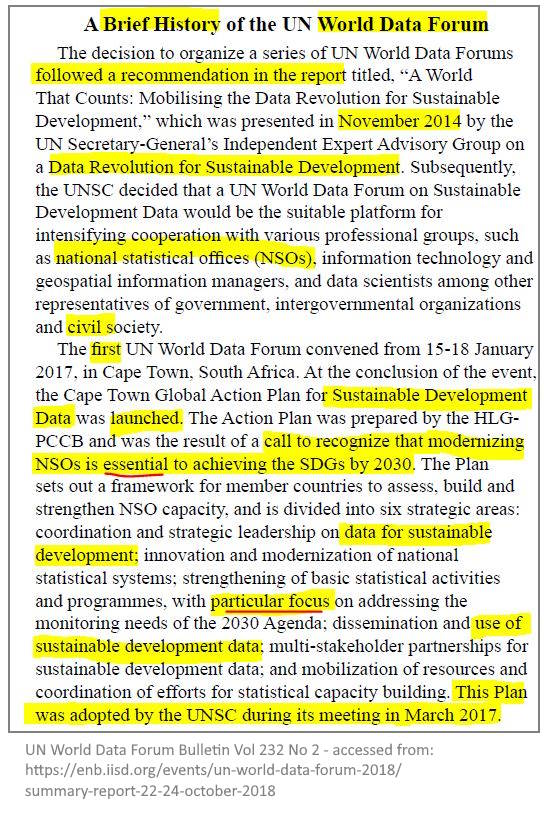
“The decision to organize a series of UN World Data Forums followed a recommendation in the report titled, “A World That Counts: Mobilising the Data Revolution for Sustainable Development,” [6] which was presented in November 2014 by the UN Secretary-General’s Independent Expert Advisory Group on a Data Revolution for Sustainable Development” [5]
On day three in the session titled ““Capturing the 21st Century through Data and Algorithms.” Speakers emphasized that the public’s world view and knowledge do not mirror reality, and suggested that schools are better places to create a more fact-based world view than the media; emphasized the value of building narratives from data to steer the narrative to implement the SDGs…”
CEPI is launched
The Coalition for Epidemic Preparedness and Innovations (CEPI) was officially launched at the World Economic Forum (WEF) in Davos, Switzerland on January 18 2017, “in response to expert reports into the 2013-16 Ebola outbreak, calling for a new system to stimulate vaccine development based on collective action and partnerships across sectors and countries”.
The are stated to be “a new alliance to finance and coordinate the development of new vaccines to prevent and contain infectious disease epidemics”. It is structured as a “global coalition to create new vaccines for emerging infectious diseases” “for which no vaccines have been created” and prepare for “Disease X.”
CEPI is a public-private collaboration with it founding partners the governments of Germany, Japan, Norway and India, the B&M Gates Foundation and the Wellcome Trust, plus Pharma companies: GSK, Pfizer, J&J, Merck & Sanofi. The Chairperson of CEPI is Australia’s Jane Halton [1, 2]
CEPI is instrumental in the COVAX vaccine rollout, plus formed a partnership with CSL and University of Queensland to bring COVID-19 vaccine to market.
On September 5, 2020, just 9 months after launch they put a call out for proposals for vaccines that can reduce development time.
Donald J. Trump’s Inauguration as the 45th President of The United States of America
On January 20, 2017 Donald J. Trump was sworn in as the 45th President of the United States of America. On that inauguration day Trump delivered a powerful speech.
Ten days earlier and Jan 10th, Dr Anthony Fauci delivered his keynote speech to the Georgetown Global Health Initiative, stating during the next administration (Trump’s) they WOULD experience an infectious disease “surprise outbreak“.
Fast forward SARS-CoV-2 outbreak likely from a lab in China
Bill Gates’ “prophecy” at Munich Security Conference – CEPI: to enable a vaccine in 90 days or less
“Prophetic” quotes from Bill Gates speech [1] at the Munich Security Conference on February 17, 2017 , setting the stage f:
“I decided 20 years ago to make global health the focus of my philanthropic work”…I spend a lot of my time on the effort to eradicate polio…
It’s also true that the next epidemic could originate on the computer screen of a terrorist intent on using genetic engineering to create a synthetic version of the smallpox virus . . . or a super contagious and deadly strain of the flu….The point is, we ignore the link between health security and international security at our peril.
The good news is that with advances in biotechnology, new vaccines and drugs can help prevent epidemics from spreading out of control.
Vaccines can be especially important in containing epidemics. But today, it typically takes up to 10 years to develop and license a new vaccine. To significantly curb deaths from a fast-moving airborne pathogen, we would have to get that down considerably—to 90 days or less.
We took an important step last month with the launch of a new public-private partnership called the Coalition for Epidemic Preparedness Innovations (CEPI). The hope is that CEPI will enable the world to produce safe, effective vaccines as quickly as new threats emerge.
The really big breakthrough potential is in emerging technology platforms that leverage recent advances in genomics to dramatically reduce the time needed to develop vaccines… synthetic genetic material that instructs your cells to make a vaccine inside your own body. And the great thing is that once you’ve built a vaccine platform for one pathogen, you can use it again for other pathogens. You only need to substitute a few genes.
The third thing we need to do is prepare for epidemics the way the military prepares for war.
It is encouraging that global alliances like the G7 and the G20 are beginning to focus on pandemic preparedness…
Pandemics are everyone’s problem—and as leaders, we cannot ignore it.
…we face today with biological threats. We may not know if that weapon is man-made or a product of nature. But one thing we can be almost certain of. A highly lethal global pandemic will occur in our lifetimes.
I view the threat of deadly pandemics right up there with nuclear war and climate change.
AAP/IAC are “challenged” by Trump’s vaccine safety concerns
On April 13, 2017 the American Academy of Pediatrics (AAP) attended an Immunization Action Coalition (IAC) webinar titled “Vaccine Challenges in a New Administration“. Their presentation slides show their “alarm and disdain” about President Donald Trump’s vaccine safety concerns and they singled out Robert F. Kennedy Jr. (RFK jr) [1, 3]
They knew that Trump was “not beholden to the pharmaceutical industry” as he didn’t accept funding to get him elected in 2016 [though did for his inauguration], and that he has a history of expressing concerns regarding the regressive health trends in children relative to the increasing vaccine trends.
AAP noted on January 10, 2017 that RFK jr met with President-elect Trump at Trump Tower where Kennedy was asked to chair a new commission on “vaccine safety and scientific integrity”, allegedly focused on “autism”. That same day AAP issues a statement declaring “vaccines are safe, vaccines are effective, vaccines save lives“. [2]
At a Feb. 15, 2017 – Press Conference with Robert De Niro and RFK jr before a congressional briefing the next day which was “sparsely attended”, RFK jr offered $100K reward to the “first journalist, or other individual, who can find a peer-reviewed scientific study demonstrating that thimerosal is safe in the amounts contained in vaccines currently being administered to American children and pregnant women.”
What they didn’t note was in late 2016 Trump did accepted millions in donations from pharmaceutical giants like Pfizer, for his inauguration celebrations. [4] Shortly after Trump appointed pharma connected Scott Gottlieb (March 2017) to head the FDA and then Alex Azar (Nov 2017) as secretary of HHS. RFK jr has said these two were “hand picked by Pfizer”[?] and they “killed the vaccine safety commission”!
Then over 4 days in March 2018, RFK, Jr. and 15 other advocates presented “Six Steps to Vaccine Safety” to every member of Congress, detaining the steep increase in childhood chronic illness and the actions necessary to introduce sound science and transparency to the US vaccination program. [11, 12]
The Immunization Action Coalition is a 501(c)(3) [9] non-profit founded by Deborah L Wexler, MD with a newsletter from 1990, because of a measles outbreak. By Feb 1994 they ran out of money but by June 1994 Wexler received a $100K grant from Hep B vaccine maker Smith-Kline Beecham.
By September 1994 the newsletter “expanded to include all immunizations and the organization’s name was changed from the Hepatitis B Coalition to the Immunization Action Coalition to reflect the shift. The newsletter’s title also was changed to “Needle Tips & the Hepatitis B Coalition News.”[13]
On August 30, 1995 Wexler won a funding boost of $750K from the CDC, as well as their “prized mailing list of 14,000 health care professionals”! Wexler now promotes for the CDC.
By 2021, Chief Strategy Officer, Litjen Tan MS PhD, pushes for adult immunizations. [5, 6, 7, 8, 9, 10]
Moderna: First-in-human Influenza mRNA vaccine study
In an April 27, 2017 press release the first human proof-of-concept data from Moderna’s mRNA technology platform was released. “In addition, they are the first-ever published data demonstrating a prophylactic mRNA vaccine’s ability to elicit robust immunity in humans”. Moderna distinguishes a “mRNA Therapeutic” from an “mRNA Vaccine” simply by the intent of the protein code, that being to “fight disease” versus “prevent disease”.
In a Cell paper, funded by Moderna Therapeutics, looking at the “immunogenicity by mRNA Vaccines” against H10N8 (mRNA-1440) and H7N9 (mRNA-1851) Influenza Viruses. They concluded that “LNP-formulated, modified mRNA vaccines can induce protective immunogenicity with acceptable tolerability profiles” in mouse studies and a First-in-Human Phase 1 Study with 31 human subjects (23 of whom received mRNA-1440 and eight of whom received placebo) and were followed for only 43 days, but the intent is for subjects to be “followed for up to 1 year post-vaccination for safety and immunogenicity”. [1, 2, 3]
“mRNA-1440 demonstrated strong efficacy based on Hemagglutination Inhibition Assay (HAI) and Microneutralization Assay (MN) titers, two measures of immunogenicity in response to vaccination.” Achieving antibody “titers consistent with protection at day 43.”
- Clinical trials (NCT03076385 ) began March 2, 2017
- “Adverse events (AEs) according to FDA scale were mild or moderate with 3 subjects (13%) experiencing severe adverse events, it “demonstrated a safety profile consistent with that of approved vaccines”. [4, 5]
- Until recently mRNA vaccines were not advanced into the clinic due to concerns around stability and production.
The paper states that mRNA vaccines “offer advantages in speed, precision, adaptability of antigen design and production control that cannot be replicated with conventional platforms,” and that until recently mRNA vaccines “were not advanced into the clinic due to concerns around stability and production.”
But now with the ever looming “concern for a potential pandemic and the need for an effective, safe, and high-speed, and scalable vaccine production platform, the mRNA-based vaccines make them ideally suited to impede potential pandemic threats.”
First G20 Health Ministers – MARS pandemic simulation
Each year G20 Presidancy is allocated to a new country, on December 1, 2016 Germany was awarded the role, which during it’s G20 Presidency the German Government, led by Angela Merkel, leveraged “health” for the first time on G20 agendas by creating the Health Ministers track.
On May 19-20, 2017, at the invitation of Federal Minister of Health Hermann Gröhe, the first G20 Health Ministers meeting took place in Berlin, Germany. The purpose to focus on combating global health hazards and be better prepared for future health crises such as pandemics.
At that meeting the participants participated in a respiratory virus pandemic health emergency simulation called MARS (Mountain Associated Respiratory Syndrome). The exercise focused on multilateral coordination, with WHO’s crisis response mechanisms and the International Health Regulations (IHR). This meeting marks the start of “Global Health” becoming a constant on the G20 agenda.
Following this 2017 meeting The Center for Global Health was founded in by Prof. Andrea Winkler and Prof. Clarissa Prazeres da Costa. Germany is leading the way with global health policy, their “goal is that research results are quickly translated into meaningful and effective political measures. This is the only way we can achieve the goals for sustainable development of the United Nations, to which the Federal Republic of Germany has also committed itself.” [1]
“Due to the increasing interconnectedness of our world, health has also become an issue that needs to be viewed globally.”
In 2016 China held last G20 meeting, which “laid the foundations” for “anchoring the topic of international health in the communiqué of the Heads of State and Government for the first time”. In her opening statement, Merkel even mentioned the 1918 Spanish flu! [2]
NIAID convenes Universal Flu Vaccine workshop
In June 28-29, 2017 the NIAID convened a workshop in Rockville, Maryland titled “Pathway to a Universal Influenza Vaccine“, which was attended by 150 scientists from academia, industry, and government from around the world to develop criteria for defining a universal influenza vaccine, one “that would cover most or all seasonal strains of influenza, and also provide protection during a pandemic”
The workshop findings, jointly authored with Dr Anthony Fauci weere published in the journal Immunity on October 17, 2017, outlining four key criteria that a universal vaccine should meet. [1, 2]
From this publication the NIAID’s strategic plan for developing a universal influenza vaccine emerged in February 28, 2018, followed by the creation of the Collaborative Influenza Vaccine Innovation Centers (CIVICs) center in 2019.
G20 Berlin Declaration
At the July 7-8, 2017 G20 Summit, the Berlin Declaration “Together Today for a Healthy Tomorrow” was declared with “seven-page final resolution on pandemic preparedness and antimicrobial resistance.” [1, 2, 3]
Global health , to “leave no one behind”, is top of the G20 agenda.
On June 28, 2017 a coalition of “33 leading Global Health organisations and members of National Parliaments have issued an open letter to G20 Heads of State, to prioritise health and establish the G20 as a permanent global health policy forum. With a Call to Action strongly urging the G20 to commit investment in research, innovation and development of innovative health technologies to counter threats posed by pandemics, poverty related disese and more. [6, 7]
And so was formed the G20 Health Development Parnership (G20HDP) with the mission “to mobilise, through political, intellectual, social and economic capital, the means required to meet Agenda 2030”. [4, 5]
WHO release SDG Health Price Tag
“The SDG Health Price Tag, published July 17, 2017 in The Lancet Global Health, estimates the costs and benefits of progressively expanding health services in order to reach 16 Sustainable Development Goal (SDG) health targets in 67 low- and middle-income countries that account for 75% of the world’s population. [2]
The analysis shows that investments to expand services towards WHO’s priority goal of universal health coverage and the other SDG health targets could prevent 97 million premature deaths globally between now [2017] and 2030, and add as much as 8.4 years of life expectancy in some countries…. the poorest nations will need assistance to reach the targets.”
Under the “ambitious” scenario, achieving the SDG health targets would require new investments increasing over time from an initial US$ 134 billion annually to $371 billion, or $58 per person, by 2030. …As many as 32 of the world’s poorest countries will face an annual gap of up to US$ 54 billion and will continue to need external assistance.
The ambitious scenario includes adding more than 23 million health workers, and building more than 415 000 new health facilities, 91% of which would be primary health care centres.
Promotional WHO info Graphics [1]
CEPI push for a rapid, new vaccine platform
On September 5, 2017, just 9 months after the launch of CEPI, they put a call out for proposals with the aim to identify new vaccine platform technologies that would enable rapid vaccine development, elicit rapid onset of immunity, and whose production can be scaled-up quickly to respond to the next pandemic disease, soon to be called Disease X. Funding from B&M Gates Foundation and NIAID.
On October 15, 2019 , CEPI launches a “new call for innovative platform technologies to rapidly respond to Disease X” on the back of the September 2019 GPMB “A World At Risk” report!
TGA adds Black Triangle Scheme for drug and vaccine adverse event reporting
On October 12, 2017 the Therapeutic Goods Administration (TGA) added the Black Triangle Scheme (BTS) to their safety monitoring system. [1, 2]. “A similar Black Triangle Scheme currently operates throughout the member states of the European Union, including the UK.”
Five months before Provisional Registration which is added to the Therapeutics Goods Act in March 2018. All new and Provisionally Registered (PR) products fall under the BTS to help monitor for early safety signals. Product Inserts (PI) and Consumer Medicines Information (CMI) are indicated with a black triangle symbol [2, 3] which will appear for a period of not less than five years from start of PR. Sponsors are responsible to supply information for PI and CMI documents.
An adverse event is definded as “any unfavourable and unintended sign, symptom or disease associated with the use of ” the provisionally registered product and all “should be reported” by either consumers but most importantly health professionals, although the TGA don’t openly share this advice for COVID-19 vaccine products.
All 2021 COVID-19 vaccines were only Provisionally Registratered, which is distinctly different to Registered. [4]
United Kingdom’s drug regulator MHRA also has a Black Triangle Scheme, for continued monitoring of medicines, which appears to have been in place since June 1, 2009. [5] The European Medicines Agency (EMA) in 2017 was responsible for maintaining the list of black triangle products which included AstraZeneca, Moderna, BioNTech, Janssen COVID-19 vaccines.
It seems Black Triangle Scheme is not unique to Australia, but infact a global regulatory practice which the TGA adopted.
Timeline pages:
1800s | 1900-1945 | 1946-1979 | 1980-1999 | 2000-2015 | 2016-2018 | 2019 | 2020 | 2021 | 2022 | 2023 | 2024