
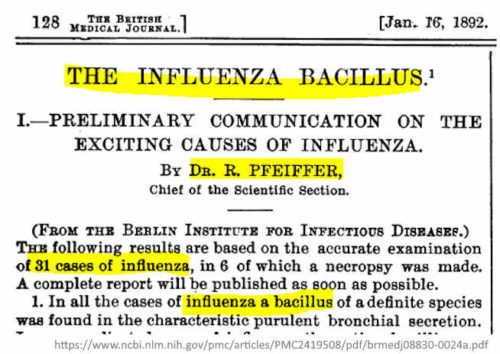
 Following the examination of sputum from 31 patients who had died in 1889-90 flu epidemic, German bacteriologist Richard Pfeiffer discovered a new type of bacterium which “appear as tiny little rodlets”, it was reported in the British Medical Journal in January 1892. Pfeiffer was chief of the Scientific Section of the Berlin Institute for Infectious Diseases and a protégé of Robert Koch, as such people believed his findings. [1]
As the bacteria we found only in flu victims he considered himself “justified in pronouncing the bacilli …to be the exciting causes of influenza“. He named the bacterium Bacillus influenzae, but it was commonly referred to as Pfeiffer’s bacillus.
Pfeiffer’s bacillus was thought to be the causal agent for influenza during the early part if the 1918 pandemic, an “influenza vaccine” was even made, though dispute arose as the “bacilli” could not be isolated from all influenza cases or victims, and was found in asymptomatic persons. [3, 4, 5, 6]
Today the gram-negative coccobacillus is classified as Haemophilus influenzae in honour of it’s mistaken connection to influenza. [2] In 1995 H. influenzae is the first living organism (other than a virus) to have its genome fully sequenced. [7]